It seems like yesterday when we were faced with ice, sleet, and the loss of electricity, yet here it is: May 09 2021, Mother's Day, and even with this Sunday forecast to be mostly cloudy, the temperature is expected to be around 88° (and humid). A scant 23 days from now it will be the start of the 2021 Hurricane season as well.
This months update has some new (and old) listening and reading enjoyment for most of you. In the listening dept. I've added several new QSO's to listen to (upper right corner):
UK Freeband Net of May 2nd
Tango-Charlie Net from yesterday (May 8th)
And older hams discussing dating in the modern world
SHACK NEWS DEPT.
Several rigs sacrificed their lives to enable me to purchase a new QRP transceiver, ICOM's new IC-705. Since it's arrival, and after playing around with only a few of it's many features, I think I feel good enough about the 705 to slim the shack down even further.
Beyond financing, the biggest obstruction I had to overcome to buy this ICOM was it's ergonomics - It looked like a large detachable head that was missing it's body, and to me it looked almost unnatural. I've owned several FT-817's over the years and while tiny, it looked like a complete radio that was ready to be tossed in a backpack or just slung over the shoulder using a strap. Once I got past the appearance hurdle it was "Game On". I don't want to tell you too much about my experience with this marvelous portable QRP rig at the moment, as I would prefer it all to be in one blog post as a review, so 'nuff said about the 705 for now...
OLD NEWS DEPT.
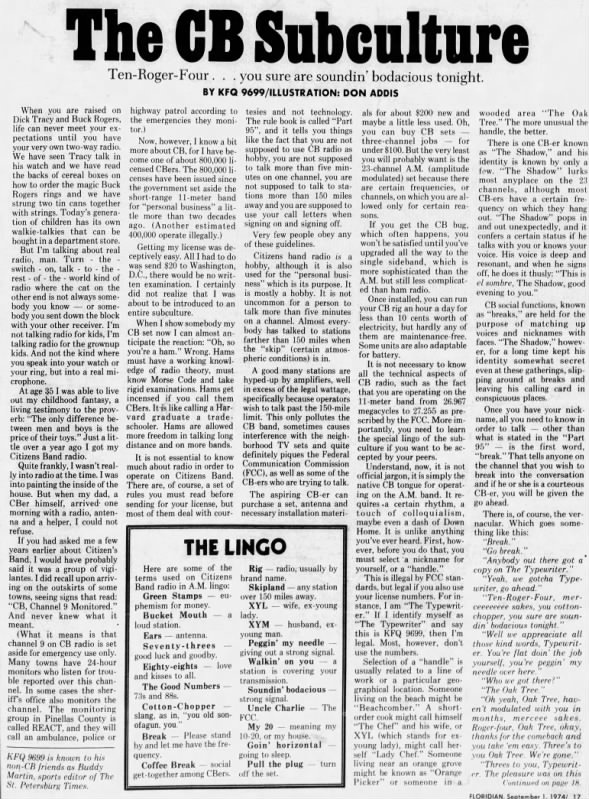
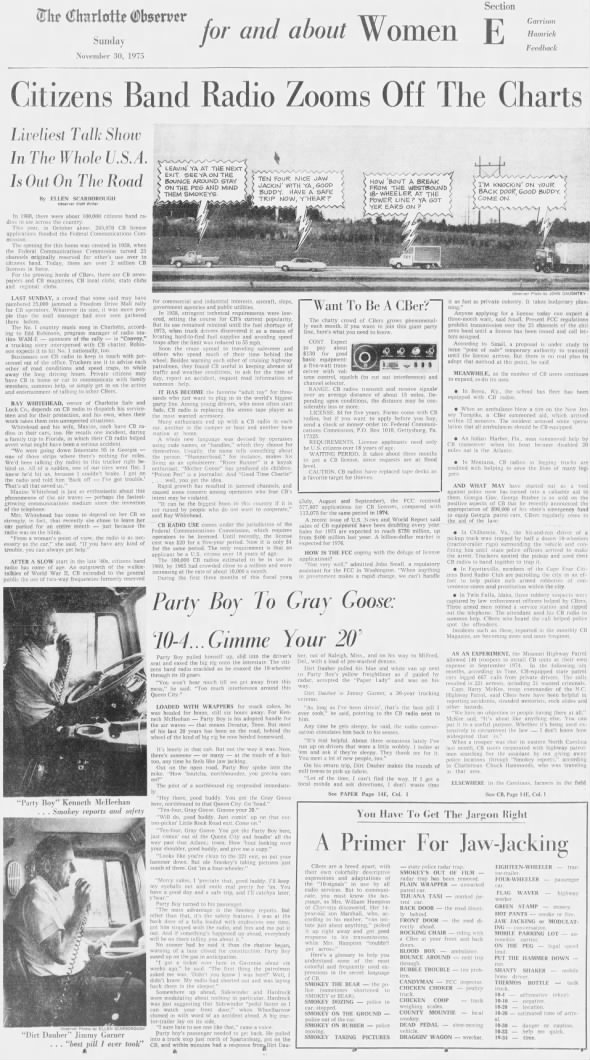
As you noticed last month, I posted an old newspaper article about CB radio which seemed to be popular with many of you, so I'm going to do this periodically, perhaps once a month. This months piece comes from 1974, and is entitled "THE CB SUBCULTURE".
Continuing on with this 25 year nostalgia trip is "The Browning Story" Part 2, written for the Gazette by Bob Milam -
CLICK ON IMAGES TO ENLARGE
This issue had the usual columns ( CB, Ham, etc.) along with an article in the "Collecting CB" column by Charles Zafonte, regarding tube neutralization, and a short review of the Uniden Grant XL. It wasn't the biggest/baddest magazine around, but I tried to pack as much as I could afford (cost of printing), and you should be able to view/download it HERE.
1996 was a
good year for the CB Gazette. At the time there wasn’t a lot a CB manufacturer
history-related-information on the Internet other than a few questions and
answers on a small cluster of websites, focused on Citizens Band radio. Glenn
Hendrix was just getting started with his Browning website and specific
locations like Yahoo “groups” either didn’t exist, or were just beginning. This
left many knowledgeable folk, like Bob Milam, Todd Evans, and Charles Zafonte, Dave Hall
(and others) with plenty to say but no place to say it other than through their own person-to-person radio QSO’s, phone calls, an occasional mention in the CB column of Popular Communications,
or - the CB Gazette.
It was around this time I began to publish more CB radio
manufacturer origin stories, written by some of the more knowledgeable CB radio
history buffs around at that time. One such historian, Bob Milam, had started
out as my West coast finder/picker for all
things old involving CB radio. If it was for sale or trade and worth a hoot, I could
count on Bob to bring me and the seller together (while, as most radio liaisons did in those days, he collected a small
percentage of the sale from the seller). As the Gazette grew, from 2 8.5 x 11 pieces of paper stapled together Bob (and others) ended up being semi-regular guest contributors. He and I spent a lot of time (and $$$ to the phone company) on countless landline QSO’s that all revolved around
2-way radio, both CB and Ham, but as real life often does, the twists and turns of life's changes
eventually slowed the number of these calls each year until finally
ceasing after the turn of the Century. It was shock to my system when I received an e-mail from Bob’s wife letting me know of
his passing. I would like to tell you that I circled that date on a calendar – but I
didn’t, so now I can only place the email somewhere in the 2013-2016 time frame.
It's never a "given" but many of us, somewhat selfishly, expect their friends and acquaintances to live just as long as we do, but when circumstances flip that given on our collective heads - it can hurt.
One of the
most popular sections of my former publication were articles that dealt with Citizen Band Radio's
history, and about the fabled manufacturers, along with the radios they built - something newbies could only hear about during those late evening/middle-of-the-night QSOs where fellow radio operators would huddle by their speakers while listening to a friend tell a story about some long gone company, that perhaps they had been told years earlier by another friend.
I like a good story
as much as anyone, so the Gazette featured articles that served as origin
stories for some of the legendary manufacturers of CB’s Golden Age: like Browning Laboratories, General Radiotelephone, and Tram (to name a few). Of all the long gone
manufacturers, Bob had two favorites: The General Radiotelephone company and Browning
Laboratories, so it's fitting that this is one of first articles I re-post, a celebration the 25th anniversary of his first article(s) his story
about Browning.
So it's with great pleasure that i once again present, Bob Milam’s “The Browning Story” (part one)...
SO ends the beginning of my "Retro-Year". Of course, part two of Bob's story will follow next month (March), and if anyone would like their Browning shack photo's in this Browning "special" please send them to me via email (along with any pertinent details/information)
A curious trend in the Citizens Band radio family tree occurred in the mid-70's: Stylish telephone handsets connected to regular CB radios.
Except for the handset, nothing distinguished these radios from models having a standard microphone (other than rx audio piped to handset). If someone bought one of these they'd have the neighbors (and probably thieves) believing that you had a very expensive mobile phone system.
Or maybe it was just the "cool factor".
In any case, some sales rep convinced some department head to manufacture a few models because they felt it was something that would differentiate their radios from all of the other manufacturers. This led to the "You showed me yours, now I'll show you mine" effect and before you knew it, many of the big CB radio leaders were offering competing models.
THIS IS WHAT A REAL MOBILE TELEPHONE LOOKED LIKE IN THE OLDEN DAYS
This was known as the Mobile Telephone Service, or - MTS, and the very first system came to existence at BELL, which ends my history lesson about MTS, however, if you're so inclined to know more about MTS, just click on the link(s).
While the market didn't see a major switch to telephone handsets
until 1975, it was not a new concept. One of the earliest CB radios, Radson's RT-75A, was equipped with one from the get-go. Like many early CBs the RT-75 lacked any of the bells & whistles you've come to take for granted today, only having on-off and push-to-talk transmit switches...
"S-METER?" "WE DON'T NEED NO STINKING S-METERS
YES, you too could have this cool radio mounted on your very own tractor (HINT-HINT to MOWER JUNKIE)
MOVING ALONG... HERE ARE SOME OTHER MODELS...
TRC-426
EFJ MESSENGER 130A
EFJ MESSENGER 132
EFJ MESSENGER 132
THIS IS ONE OF THE HARDEST TO FIND GE CB RADIOS
THESE EARLY RADIOS OFFERED YOU A CHOICE - Microphone or Handset
ADVERTISEMENT LAFAYETTE COM-PHONE 23
LAFAYETTE COM-PHONE 23
LAFAYETTE COM-PHONE 23
ARTICLE REVIEW: POPULAR ELECTRONICS
** Compared to the standard CB radio the adjacent channel rejection (ACR) at 60dB was actually pretty good, perhaps slightly above many other rigs, and better than the ones whose ACR fell below 50dB.
Back in the good 'ol days a lot of us "CBer's" lurked in the shadows near the local news stand, when word got out that the next year's CB "Buyers Guide" would soon be available. Besides the fact these issues were like an adults version of the Sears Wish book, you could find anything and everything that had to do with CB. All radios were listed by each manufacturer in alphabetical order, usually, but not always with photos of each individual radio model.
Beyond getting a look at a new radio, a prospective buyer could compare a radios specifications with another model. Most of the numbers were close enough to be considered equal, but occasionally you would run across a few surprises; both good, and bad.
FIG. 1: SPARK-O-MATIC CB-5000 WITH ACR OF -45dB
FIG. 2: LAFAYETTE TELSAT SSB-140 WITH -70dB ACR
If you've followed my articles over the last 30+ years you know that one 'spec more than any other could make or break how I felt about a radio while doing a "Hands On" review, and that specification is the adjacent channel rejection (ACR).
This was really important to me, back when you could find a base CB antenna poking the sky, every mile or so apart from each other. This created a nightmare for those of us using base stations - bleedover was killing everyone, especially if you had bad ACR to begin with...
Anything under 50dB usually got a FAIL from me, and I realize now that it may not have any relevance to everyone else, so I've been adjusting some past reviews as time allows. But in the 70's I obtained some relief from a several close-by neighbors when I bought a Johnson base station. It was much better than the Midland 13-880B I was using (but still had to use if I wanted to talk on the lower side).
LAFAYETTE COM-PHONE 23
CATALOG 760 PAGE 3 - HOTLY PROMOTED ITEMS WERE USUALLY FOUND IN THE FIRST FEW PAGES OF THE CATALOG. BY CONTRAST THE REST OF THEIR CB LINE APPEARS MUCH LATER IN THE CATALOG, AS SHOWN BELOW
CATALOG 760 PAGE 227
MIDLAND 77-963
MIDLAND 13-886
ANOTHER ONE YOU DON'T OFTEN SEE: SANYO TA-777
TEABERRY TELE-T
So there you have it; as many tele-set CB radios as I could remember (and a few I didn't know of until doing this blog post). Ultimately it came down to ergonomics, and the difficulty one would face if they wanted to purchase the Tele-handset knowing there was no 3rd party microphone support: Neither Turner or Astatic had handset versions of the +2/+3, of D104.
Those CB "phones" are a cool oddity to look at though.....
WELL...THIS WAS CERTAINLY A LETDOWN..
I got an email over the weekend with Subject:New President Adams! I was suddenly swept up in a wave of nostalgia, thinking about the original President Adams, and wondering how cool it would be have the new Adams side-by-side with the old Adams, comparing one to the other much like I did with President's Grant II and new McKinley.
Each of those new radios brought something new and exciting to the family tree, while maintaining solid Sideband performance. Then, I saw the new Adams and with a loud POP the air escaped from that big balloon that had formed in my brain, as I realized that this new Adams was just a punk radio that some soulless marketing snake er...person from the bowels of the company said to himself "Huh we need a name for a new President CB...let's use Adams ", without putting any real thought into that decision.
FROM THIS:
TO THIS??
AND NOW, FOR SOMETHING HUMOROUS...
This is mostly humorous to those of us who grew up seeing signs while driving around town, like the one below -