Showing posts with label microphones review shipping we. Show all posts

Friday, March 08, 2024

REVIEW: THE PRESIDENT DIGIMIKE


THERE'S A NEW MICROPHONE IN TOWN, AND IT MEANS BUSINESS

WITH CAVEOTS


It's not often you find a manufacturer bringing new microphones to the market, and many operators opt for legendary brands like Astatic when they feel the need for a replacement microphone, whether it's a power mic, or noise-cancelling microphone. If the word hasn't gotten around to you yet, those microphones look the same, but I've heard many people moan about PTT (Push To Talk) switch failures in the first year, as well, a lot of the new radios don't work well with these older dynamic microphones. To be fair, some, but not all radios now have the ability to select either Electret or Dynamic within the menu system;  but added to the fairness, a year or two ago I tried this method with a Turner RK76 on a radio that had the capability to pick the type of mic being used and the audio wasn't what I expected it to be, so I ended up just putting the stock mic back on the radio. Let's look and see what sort of difference this new microphone makes...


"Noise Cancelling" is the topic, but not all noise cancelling microphones are created equally. While this microphone falls into the NC category, it's about as close as you can get in comparison to the others because unlike a lot of noise cancelling mics, which just use thicker foam in front of the element, or move the element further back into the microphone, the President Digimike has an an actual NRC (noise reduction circuit) chip/circuit inside the microphone, using the same voltage that comes from the radio, through the mic cord, to power the Electret mic element.

My usual approach when reviewing a mic is slightly altered for this one - because it's so special. I'll start with my very first impression of this microphone the first time I held it -


WEIGHT


It has some "heft" to it - and this is good! Not too much to make it tiresome to hold on a long QSO, and not so lightweight where you'd spend half the time talking on it, at the same time wondering if there was anything inside it. For the most part I think we'd all agree that today's stock microphones tend to feel cheap. The plastic case is robust, and its the shape fits your hand like a glove. The microphone cord is a good length with a decent amount of cord thickness, unlike the cords being used on other brand radios. Good job President!


Besides the PTT switch (a.k.a. the "Green Monster") there are only two other buttons you will use daily: UP & DN. The middle rectangular button is used to set your NRC, and once set, you probably won't have to use it again.

Reading directly from a green card which was wedged in the manual:

"The DIGIMIKE microphone is designed to make your modulation as clear as possible in all modes by eliminating the background noise."

The filtering levels go from 1 to 5, and if you don't have talkback, or another radio in the room to listen to your voice, I'd suggest having a friend help you figure out which setting worked best for you. For instance, if you're familiar with ham radios that incorporate DSP, then you know that the more DSP you add can lead to disconcerting watery audio. Personally leave mine set to 1, only occasionally bumping it up a notch to 2 if the background noise is really bad *NOTE: even if you set this mic to 5 it won't neutralize a cat wailing in the background waiting for his or her lunch, and at the 5 setting the middle button will stay solid green.

THERE IS A SOLID PIECE OF METAL ALLOWING YOU TO SECURELY HANG IT ON A MIC CLIP, ALSO, THE SECRET OF THE MICROPHONES WEIGHT ARE TWO METAL PLATES MOUNTED INSIDE THE BACK PANEL OF THE MICROPHONE. IT LOOKS LIKE IT COULD BE POSSIBLE TO REMOVE ONE PLATE AND LIGHTEN THE LOAD, BUT I DIDN'T EXPLORE THAT OPTION BECAUSE I WAS HAPPY THE WAY IT CAME.


The green card also mentions that this microphone will also work well with VOX usage, provided your radio has that feature. The manual itself explains the colors of the middle button you change the NRC strength.

Along with those instructions, there is a very easy to follow mic wiring diagram.


WARRANTY

Pleasantly, in an age where warranties are rarely given their fair due by the manufacturer, this microphone is warranted for 2 years. Can you believe the warranty would be the hardest part of this review? I looked on President EU's site and was led to believe it was 2 years. "Brilliant" I said. Then I looked on the USA website and finally under general accessories, of which microphones are part of it only has a 6 month warranty. Even the Astatic hand mics with faulty PTT switches give you a year's warranty.

Amazon gives you 30days, Bells - 60days, Walmart - 30days in-store return, but for $2 you can make the warranty 2years.

This is the what you'll find in the manual:

WARRANTY (In accordance with the warranty conditions in the country of purchase)

  • Important: Proof of original purchase is required for warranty service.
  • WARRANTOR: GROUPE PRESIDENT ELECTRONICS (''PRESIDENT")
  • ELEMENTS OF WARRANTY: PRESIDENT warrants, to the original user, if purchased from a retail store, that this PRESIDENT product will be free from defects in materials and craftsmanship, subject to the limitations and exclusions as set out below.
This warranty extends only to the original user. The warranty will be invalid if the Product is (A) damaged or has not been maintained in good condition through reasonable maintenance, (B) has been modified, altered or used as part of any conversion kits, subassemblies, or any configurations not sold by PRESIDENT, (C) improperly installed, (D) serviced or repaired by someone other than an authorized PRESIDENT service center for a defect or malfunction covered by this warranty, (E) used in any conjunction with equipment or parts or as part of any system not manufactured by PRESIDENT, or (F) installed or programmed by anyone other than as detailed by the owner's manual for this product.

STATEMENT OF REMEDY

  • In the event that the product does not conform to this warranty at any time while this warranty is in effect, warrantor will either, at its option, repair or replace the defective unit and return it to you without charge for parts, service, or any other cost (except shipping and handling) incurred by warrantor or its representatives in connection with the performance of this warranty. Warrantor, at its option, may replace the unit with a new or refurbished unit. THE LIMITED WARRANTY SET FORTH ABOVE IS THE SOLE AND ENTIRE WARRANTY PERTAINING TO THE PRODUCT AND IS IN LIEU OF AND EXCLUDES ALL OTHER WARRANTIES OF ANY NATURE WHATSOEVER, WHETHER EXPRESS, IMPLIED OR ARISING BY OPERATION OF LAW, INCLUDING, BUT NOT LIMITED TO ANY IMPLIED WARRANTIES OF MERCHANTABILITY OR FITNESS FOR A PARTICULAR PURPOSE. THIS WARRANTY DOES NOT COVER OR PROVIDE FOR THE REIMBURSEMENT OR PAYMENT OF INCIDENTAL OR CONSEQUENTIAL DAMAGES.
  • Some countries do not allow this exclusion or limitation of incidental or consequential damages so the above limitation or exclusion may not apply to you.
  • LEGAL REMEDIES: This warranty gives you specific legal rights, and you may also have other rights which vary from country to country.

PROCEDURE FOR OBTAINING PERFORMANCE OF WARRANTY

If, after following the instructions in the owner’s manual you are certain that the Product is defective, pack the Product carefully (preferably in its original packaging). The Product should include all parts and accessories originally packaged with the Product. Include proof of original purchase and a note describing the defect that has caused you to return it. The Product should be shipped freight prepaid, by traceable means, to warrantor at

    Groupe PRESIDENT ELECTRONICS
    Route de Sele – BP 100
    34540 BALARUC
    FRANCE
    Group PRESIDENT ELECTRONICS
    1007 Collier Center Way,
    Naples, Florida 34110
    USA.


And yet - there is no mention of how long a warranty you have. After several back'n forth emails and texting with various President reps apparently 6 months is all you get. So I would recommend if the store your buying it from offers a extra year or two for a few bucks - Take it!

WHAT WAS MY EXPERIENCE?


My experience was absolutely brilliant! I found that when I had the NRC set to No.1 on the mic it was enough to keep out background noises in the shack and SUV. Now if I was in a noisy construction zone with a window down, allowing jack hammers, other assorted freeway noise (Road Rages), and the Elmer's Glue of the atmosphere (i.e. the sticky moist air from the the Gulf coast of Texas) coming at me I'd probably think about bumping it up a notch 😏

I'm not the only one who has mentioned this, but while this has a noise reduction circuit, and no other visible (inside or out) adjustable control, this microphone, which works very well cancelling background noise apparently cleans and boosts the audio as if it were a Noise Cancelling Power Microphone. Except for those days, decades away, when I'd put a Turner Plus 3 desktop microphone, I haven't heard so many unsolicited compliments on my audio. Before I wrap up the audio report part of the review:

  • There is no volume control on the microphone because it's not a power mic, it's a noise canceling microphone using President's NRC (noise reduction circuit), so you can only change the noise reduction level (the manual has easy to read and follow instructions).
  • When talking into the microphone try to keep it 3-4 inches from your mouth.
  • By either using talkback, or recording the audio from another CB in the house I was bit flabbergasted - Not only was my voice clear to understand, but it was LOUD (compared to the stock microphone).
  • At $47 (average price) this is the best thing you could do when looking for an upgrade for your own radio.

But what if buy a president George or other model with NRC built-in? Does it make any sense to duplicate it by buying this new microphone?

When asked about this from President, the reply I got was:

" If you have the NRC activated on the radio , you can deactivate it in the digimic.

Or activate the radio NRC on receive only if you want to use NRC activated digimic."

If you're short on cash buy the radio and use the NRC that's already inside it. If you have plenty of money to spend, you can get the microphone. The shape and weight is nice, and the audio is crisp. The choice is yours. Or, if you have a McKinley, put the microphone on it.


**Note, this is wired to the 6-pin connector all President radios use and you shouldn't have any issues. Regarding other brand radios? If they have a 6-pin connector with voltage on 1 wire to power the Electret element, I'd guess it would work as well, but talk to the dealer you're buying the mic from and get the final word from them.  I've read in various online radio groups that some operators with radios using the RJ-45 network cable jack seem to have issues. Make sure you ask your dealer about this as well.

I own two of these microphones currently. One is on my President McKinley, and the other one is on my President George FCC, yet I need another one for my second President George II, only this time, I'm tossing my loose change into the jar to get their new Blue Tooth microphone with NRC*. Not just to review, but I think having a decent microphone that is more-or-less hands free can only be a bonus to those of us running CB radios as we traverse the often treacherous traffic. Having the mic element w/channel Up & Down buttons on the steering wheel is is great idea - less distraction while driving.

*I hope to have one of these mics to review shortly and it'll probably get posted after I finish my review on the Radioddity QT-60 (Hint...it's a nice radio).

** There was a question or two that I passed along to President. When I get and answer, or, should something drastically change my opinion of any item I review, as always, I'll make the adjustment or additional information available on the original review.

Last but now least, you'll find a pretty good actual tryout of the mic here: (169) President DIGIMIKE Overview and Demonstration - YouTube


 73

WOODY


Note: Updated May 2026 with verified historical link corrections

Tuesday, September 01, 2020

THE TURNER MICROPHONE STORY (AND EVERYTHING YOU ALWAYS WANTED TO KNOW)


TELLING THIS STORY WAS A HUGE

"UNDERTAKING"
 (HAH)


Back in the early days of the CB Gazette I had links to several pages of information about the Turner microphone company compiled by Eric Braun. Several times over the years the website hosting his pages were changed, I would track Eric down to get the new IP address, update my links, and everything was back the way it used to be - until it wasn't (those pages are no longer available online). 

I have his pages in my offline archive but I was unsure if I should bring them back from the archived crypt , or not, and ultimately to assemble as much information as I could get, gleaned from many sources including actual news clippings, to create a definitive article about Turner Microphone's history.


 February 18, 1951 By Ed Murphy, Gazette Staff Writer
PAGE FROM ORIGINAL Eric Braun Link 


In May of this year an article, about the history of the Turner Microphone Company, written by Joe Coffey, was published by the Cedar Rapids Gazette I started thinking about Eric's webpages, Joe Coffey, and then Ed Murphy's 1951 article, and it seemed to me that this would be a good time to write something that tied everything together in one article (I have link to that article located towards the bottom, under "LINKS AND ADVERTISEMENTS").

In CB, when you think about buying a new microphone as an upgrade (to the stock mic that originally came with the radio), two names usually jump to the top of the list: Turner, and Astatic. I am using CB as an example because Citizens Band radio was wildly popular in the 60’s and 70’s, a period that solidified these two companies as Legends

Both started earlier in the last Century, producing microphones that were used in many different areas like music, broadcasting, and radio communications during WWII, but I think the Turner Microphone Company’s origin story is possibly the oddest between the two – it was started in a Cedar Rapids funeral home.

David Turner Sr. was a very successful mortician in Cedar Rapids. He was so successful his funeral parlor often had standing room only attendance which left those in the very back of the room unable to hear what was being said up front. His son, David Turner III apparently had an eye for the latest/greatest technologies and sought the help of Everett Foster, a Cedar Rapids “Radio guy”, who came up with the solution using The PA, or Public Address system. He ran the PA system from the chapel to Turner's funeral parlors at 800 Second ave. SE, and the trial run was very successful.


TURNER TIMELINE
 

•    1930 – After word spread about his system David was asked to do a demonstration of his PA system at the National Selected Mortician conference in Colorado Springs. The positive feedback solidified Turner's hunch they were on the cusp of something big. After returning to Cedar Rapids, PA system assembly takes place on the 3rd floor of the mortuary where it becomes clear that the microphone, was the systems weakest link, so a decision is made to manufacture a microphone to his own specifications.

•    1931The previous assembly area on the 3rd floor of the mortuary was relocated to 700 Third Avenue SE, former location of the old Turner Funeral home.
David also eyes advances in pressure embalming machines and begins the manufacture of a more dependable version (another very successful venture)

•    1931/32A 3rd manufacturing plant was built.To increase microphone sales Turner discontinues PA system production eliminating the competition between Turner and the other PA manufacturers. The competitors began to purchase Turner microphones.

909 Seventeenth street NE

•    1934Growth came quickly and the main plant grew to the point it was relocated to 909 Seventeenth Street NE

•    1940 – Sales were successful and the Turner Microphone company now had 35 employees. World War II broke out, and that number rose to 210. The entire  production was geared to help Allied armed forces in making Quartz crystals used in both radio equipment and microphones. Because of this, embalming machine production was halted to enable 100% war effort. Of the 200+ employees, 85% were women.

TURNER LINEUP


•    1946 – WWII ends, and the plant on Seventeenth St. was expanded.


•    1946/7 – Employee head count dropped to 50, with a concerted effort in expanding both audio and embalming machine sales. Improvements were made to the employee assembly/manufacturing areas: an art gallery of fine paintings were hung on every wall allowing employees to view them from wherever their station was located and music from the local radio station, as well as recorded music on record was piped into the building during work hours. Those ideas were ahead of their time.


•    Into the 50’s – Company President Renald Evans (1946) and vice president William Nezeerka expanded further into microphone exports. As well, the Turner Microphone company became an OEM supplier of microphones for a large number of radio set manufacturers like Collins, Hallicrafters, and EF Johnson. By now, 25% of their microphone product was being exported to over 40 different countries. 


Turner now had a sales staff of 14 and advertised in 15 different publications (Radio Electronics, QST, etc.). David Turner becomes chairman of the board of directors. Ed Murphy's article for the Cedar Rapids Gazette pointed out Turner Microphone sold 80,000 microphones in 1950.


POLY-COMM BRANDED TURNER MICROPHONE


•    Into the 60’s – Turner’s growth went hand-in-hand with the CB radio explosion, employing up to 2,000 people at its peak. 


New models like the +2 desk, and M+2 hand microphone (with an audio amplifier circuit), helped cement Turner Microphone’s legendary status among CB radio operators.

This is not to say they weren't successful in other markets - they were. Turner Microphone continued supplying OEM microphones for a variety of electronic equipment (ham radio, music, PA systems).


•    1967 – The Turner microphone company was sold to the Conrac Corporation becoming "Turner - a Conrac company".  


With the CB craze in full swing new models were introduced: +3 desk and mobile, and the Super Sidekick. 


•    1970's – The company branched out by manufacturing both base and mobile CB radio antennas. This new line was called "Signal Kicker". Sales were buoyed by the phenomenal sales of Citizens Band radios for the entire first half of the decade. 

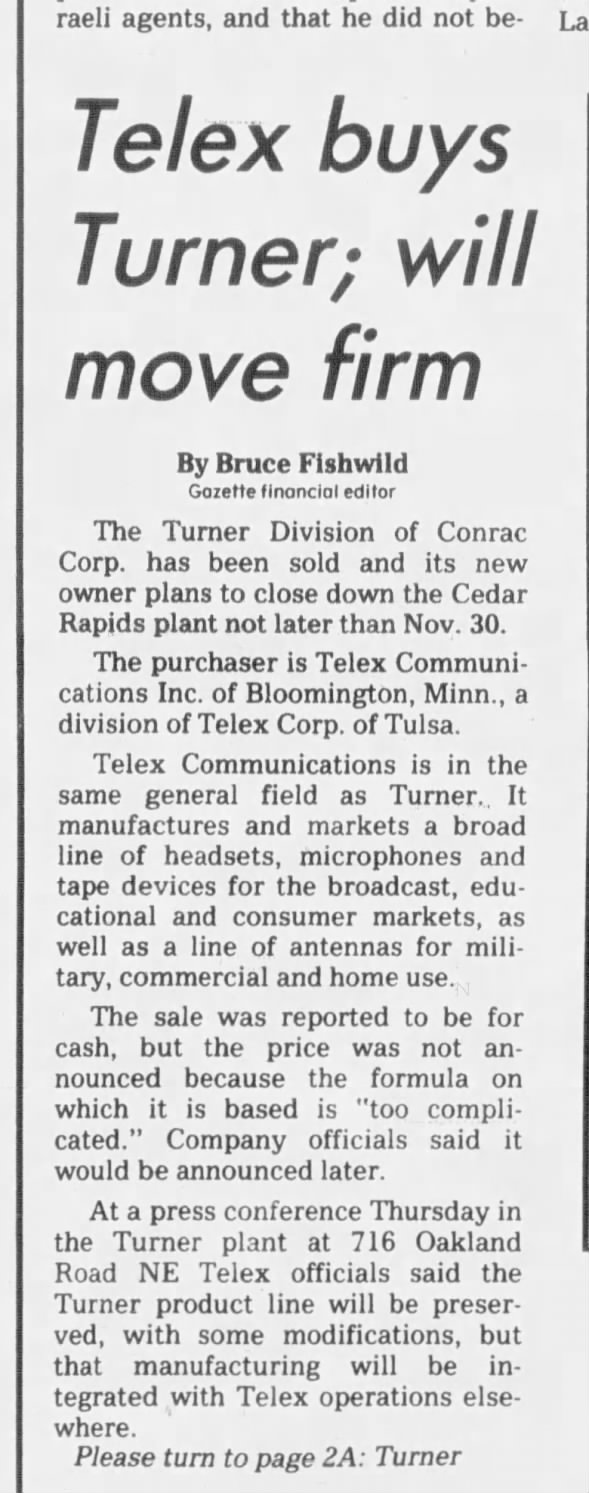
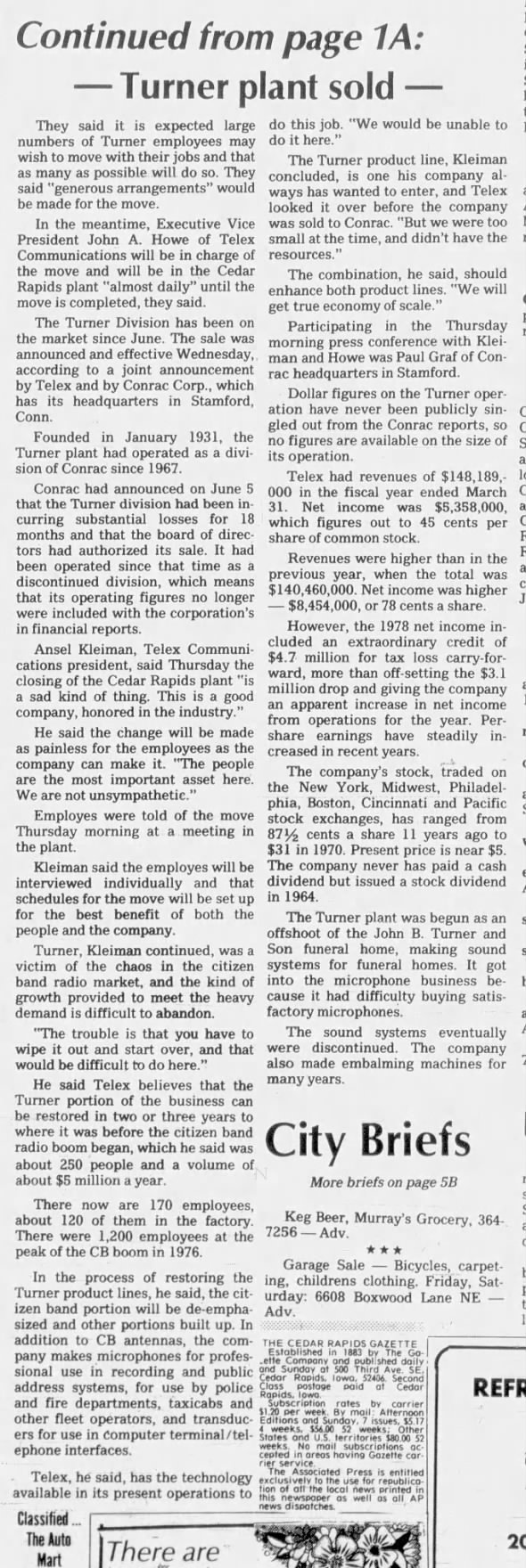
But in June 1979, Conrac revealed that Turner had been incurring substantial losses for the previous 18 months, and they were now looking for a buyer. It was no coincidence that the CB market had been rapidly shrinking as well.


TELEX OFFICES IN LINCOLN NEBRASKA

•    August 1979 – Conrac/Turner was sold to Telex Communications. The Turner manufacturing plant in Cedar Rapids was closed and relocated to the Telex facilities, which was a big deal to both companies and their employees. Telex Communications President Ansel Kleiman said the Turner Microphone product line would allow them to enter a field they'd always wanted to be a part of.


He believed that Turner's problems was due to the high percentage of product devoted to CB radio, and that the line could be tweaked, with less emphasis on CB, and return to profitability within 2-3 years.


Mon, Aug 20, 1979 – 16 · The Lincoln Star (Lincoln, Nebraska) · Newspapers.com


•    1979-early-1980's – Telex continued supporting extensions of the Turner Road King microphone line: Road King 60/66, 70/76, as well as The Expander 400 hand, and Expander 500 desk microphone. 

Turner microphones were still popular, but combined with the shrunken Citizens Band Radio market, and difficulty making inroads in other services, they yielded fewer sales as each year went by.


•    Late 1990 / early 2000’s – Telex/Turner brand was sold to Barjan, a company specializing in low-cost CB radio accessories (I'm not quite sure of the exact date).


•    2011/12 – Telex-Turner/Barjan was sold to DAS Inc., a company which also bought the rights to many other famous CB brands (Astatic, K40, Wilson, and Francis), moving manufacturing to China


OTHER FUN STUFF


TURNER MICROPHONES ARE NOT RARE NOR HARD TO FIND

There is no shortage of Turner microphones on EBAY. If you missed out on getting your dream mic (whether it be still-in-box or not), don't panic because another one just as good or better will turn up soon.

When looking to buy a used Turner M+2 hand mic, if it's not in the description, always ask the seller if they opened it up to verify that it doesn't have a moldy/rotten leaking battery inside. Because you have to remove 4 screws to get to the battery, most of these (no matter how good looking they are on the outside) still have the original moldy/rotten leaking battery inside (my .02 cents)

BATTERY DAMAGE IN A TURNER M+2


HOW OLD IS IT?

The 1950-later 60's era Turner microphones came in a dark red box. After the Conrac purchase the box was mostly white with a dark red band, later changing to a jazzed up 70's box with a image and very seventies design of orange,red, and white colors. It's really not that big of a deal unless someone is trying to sell you the jazzy 70's microphone-in-box combo along with a giant price tag - because they believe it was made in the 50's.


EARLY TURNER MICROPHONE BOXES. PRE-CONRAC


EARLY CONRAC BOX STYLE


LATER STYLED 70'S BOX


TURNER SUPER SIDEKICK

When manufacturers started rolling out solid-state Sideband radios Turner added another desk microphone to their line: the Sidekick 100, followed by the Super Sidekick microphones. Unlike the +3, which offered amplification plus a speech compression circuit, the Super Sidekick was strictly an amplified desk mike. It had a sharper, less bassy sound that worked great on AM but especially on single-sideband (I'm pretty sure we all know that a +3 sounds very good on SSB as well. Often, a lot of how you sound depends on your voice characteristics and the radio itself).


TWO SIDEKICKS

In the very beginning, the microphone was called the Sidekick 100 and other than a label with Sidekick 100 on the mic it looked exactly like a Super Sidekick. After digging around the Internet I came to the conclusion that one predated the other briefly but it wasn't for very long (I've seen advertising with both microphones in the same year). The Sidekick 100 disappeared leaving the Super Sidekick to carry on. I compared a Sidekick 100 pcb with a Super Sidekick and they appear identical, but I don't know of any differences other than the name (does anyone know if there was a different element?)


PHOTO: TURNER SUPER SIDEKICK


PHOTO: TURNER SIDEKICK 100


Another anomaly has to do with the internal PCB and the adjustment POT [which is underneath the base-plate and accessed thru a small hole in the plate]. 

While all of the Super Sidekick's I've seen have the adjustment hole, not all of them have the POT on the PCB to adjust (I ran across this between two Sidekick 100's as well). Weird.


 LINKS AND ADVERTISEMENTS (PHOTOS - CLICK TO ENLARGE)


If you're on Facebook, there's a group devoted to Turner Microphones, which you can find HERE


BATTERIES ARE STILL AVAILABLE FOR THE OLDER MICROPHONES


(TURNER, ASTATIC, ETC.)

AMAZON LINK


If you're not familiar with them, the CB Tricks website has a plethora of knowledge on just about everything CB, including microphones. CB Tricks Turner Page.


Wed., May 27, 2020 news story written by Joe Coffey and published by the Cedar Rapids Gazette. Link HERE


 TOM MOSS

 Almost 20 years ago Tom wrote a great article for the CB Gazette. It was about the Turner Microphone company and their history between 1952 and when the plant closed in the later 70's. I re-published his story on this Blog in 2009 - You would be doing yourself a disservice in not reading it (Thanks Tom!). Link HERE.


 PRESERVATION SOUND

A good website to learn more about older microphones!

Turner mics of the seventies 


Link HERE for 1940's ham mics.

Link HERE for general search results 


THE RADIO MUSEUM

TURNER MIC LINK


TURNER CATALOG

60's

COUTANT LINK


CB RADIO MAGAZINE

TURNER +3 REVIEW (LINK)


VINTAGE MICROPHONE WORLD


TURNER MODEL 98

LINK


TURNER WIRING BOOKLET


DOWNLOADABLE 


PDF


CLICK ON PHOTO'S TO ENLARGE


TURNER


ROAD-KING 70; SIGNAL KICKER AD


1977


TURNER

EXPANDER 500 AD

1977


TURNER


+2 DESK MIC PLUS A FREE LIGHTER


PROMOTION


TURNER


ROAD-KING 70 & SIGNAL KICKER AD


1977


TURNER


MODEL 333 AD


1964


TURNER MICROPHONE 


CATALOG


1972


TURNER MICROPHONE AD

1970's


TURNER M +3 AD


1970's


TURNER MICROPHONE


AD


1970's


TURNER +2 / +3


CATALOG 


1972


TURNER MICROPHONES


LAFAYETTE CAT. 670


TURNER MICROPHONE


ROAD-KING


AD (PRE-CONRAC)


TURNER MICROPHONE


SUPER SIDEKICK AD


1974


TURNER MICROPHONE


REPORT P. 1-of-2


TURNER MICROPHONE


REPORT P. 2-of-2


TURNER MICROPHONE AD


M+2 / M+3


1976


NEW PRODUCTS


POPULAR ELECTRONICS


TURNER MIC COMBO


1959


There you have it, everything I know about Turner Microphones. If I missed something let me know. If I got something incorrect, Ditto. As well, if I find additional material that I might have missed (ad's, pictures, etc.) I will edit this Blog post. I hope you leave here with a better understanding of this fine company's history -


73


Woody


TURNER +2 DESK MICROPHONE (PHOTO BY BRIAN WOODBURY @ CBGazette)


Note: Updated May 2026 with verified historical link corrections